“Writing my feelings - I normally paint them”
——————————————————
The lamb was a wolf
Thirty complaints against the same French pop star, for sexual abuse spanning three decades. The French media are shaken and debates run high. I am shocked, not entirely surprised and ultimately devastated. Patrick Bruel was very popular with young girls in the 90s and mostly owes them his fame, and remains very popular to this day. I was one of his fans back then, barely 14, in the front rows of his concerts. I had his posters on my bedroom walls and thought he was the sexiest, most charming, wonderfully human and charismatic man. Much like Take That, he represented a teenage girl's fantasy. He is not the first celebrated predator — from Picasso to Russell Brand, we know the drill, and France is not last in the game.
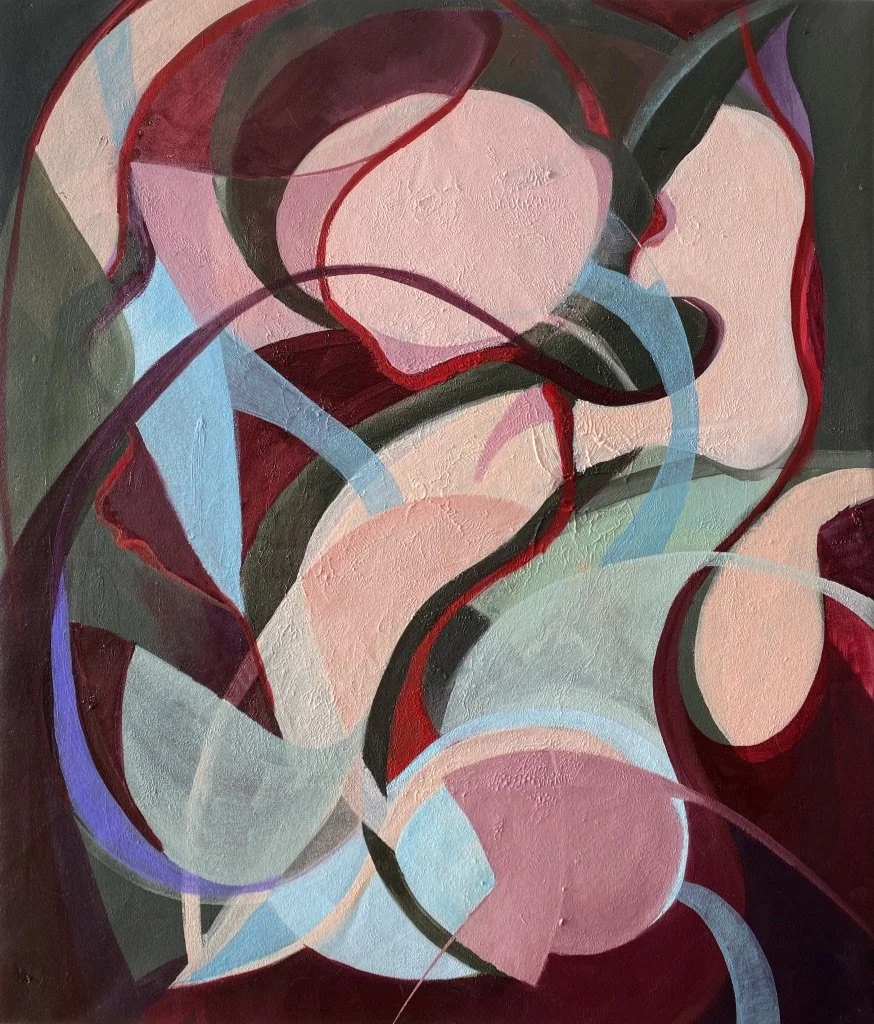
Mormon Wood, 2021, Oil on canvas, 75 x 60 cm
But this one hits hard as he embodied the carefully constructed lie of the nice guy hiding the wolf. I grew up in that crafted bubble of invisible, accepted and eventually internalised misogyny.
And so in 2011, I was outraged when French politician DSK was accused of sexual assault in the Sofitel scandal. "They'll stop at nothing to derail his election campaign, it's a setup" was my first reaction. For days, weeks — far too long — I couldn't see it. Despite everything I had experienced myself, living in Paris in the late 90s and early 2000s.
What I thought was normal back then is completely unacceptable, and women are heroines simply for having achieved so much against so many obstacles. The condescending smiles were nothing compared to the very real danger a man could pose in public space. This was the Page 3 era, the Bridget Jones years — promoting body shaming and harassment as seduction.
The start of #MeToo opened my eyes and I listed for myself what I had been through. From being groped on the tube to the encounter that made me fear for my safety, the routine street insults, the colleague casually cornering me in his office... The list was longer than I'd thought.
But society was clear: this is the lot of a girl in her twenties in Paris. That's just how it is. What am I complaining about? I wasn't even complaining. I was suffering but it never occurred to me that it could be any other way.
Until I moved to London. I was 29, and I remember the deafening calm my presence provoked on London streets. NOTHING. In any neighbourhood — I lived in Brixton. No catcalling, no 'dirty slag where's your skirt', no comment about my body: nothing. I remember that silence as a magnificent, unexpected gift. I was discovering civilisation. I don't know London before the 2000s and I may have an idealistic view of it. But I know that it was a welcome safe haven to me.
I am angry that French society didn't protect me from these hardships. And the 30 complaints against Patrick Bruel affect me particularly because they scream at me: this could have been you. I was nowhere near these circles at the time, but what about all those girls — young and innocent, like me — who came face to face with it? Who protected them? How many more men are going to reveal themselves as "problematic" and cry that it's not their fault, that the women were asking for it, that not all men. And how much longer are we going to accept it? And doubt the victims? And defend the abusers? I am tired, angry, and I feel betrayed by my society — which, granted, had never promised me very much.
May 2026
——————————————————
Patriiiiiiiick
Qu'est-ce qui a mille pattes et pas un poil sur le sexe ? Les premiers rangs d'un concert de Patrick Bruel. J'ai longtemps essayé de comprendre cette "blague" qui circulait au début des années 90, qui déjà n'était pas très drôle mais prend encore une autre ampleur aujourd'hui. C'est que j'ai été cette fille de 14 ans à peine, dans les premiers rangs de ses concerts, j'ai eu les posters sur les murs de ma chambre et j'ai pensé que c'était l'homme le plus sexy, charmant, tellement humain et charismatique.

Once upon a time, 2024, Oil on canvas, 40 x 40 cm
Ce n'est qu'un de plus. Pourquoi est-ce que je tourne en boucle à regarder mille vidéos et à ne pas y croire (ou n'y croire que trop) ? Ce n'est pas ma première "idole" qui tombe. On commence à être habituées avec les Gérards (oh non pas Darmon !) les abbés et même les comiques (RIP Russell Brand).
Là où ça fait mal pour Bruel, c'est que ça cristallise une époque.
Qu'il représente ce mensonge construit de l'homme sympa qui cache le loup. Et que j'ai grandi dans ce bordel, dans ce mensonge, dans cette misogynie acceptée.
Je comprends, en regardant ma propre misogynie introjectée, qu'il y a 10 ans à peine, personne n'aurait cru les victimes. Elles ont encore du mal à se faire entendre. J'ai été scandalisée quand en 2011 DSK a été accusé d'agression sexuelle. "Ils sont prêts à tout pour lui faire rater une élection, c'est un complot" était ma première réaction. Pendant quelques jours, semaines, je ne sais plus mais vraiment trop longtemps, je ne pouvais pas voir. En dépit de tout ce que j'ai moi-même vécu. J'ai eu 20 ans à la fin des années 90 à Paris. Ce que je pensais normal à l'époque est complètement inadmissible et les femmes sont des héroïnes d'avoir simplement accompli autant avec tant d'obstacles. Les sourires condescendants ne sont rien comparés aux dangers réels que l'homme peut représenter dans l'espace public. Ce sont les années Ardisson, l'époque où Pivot s'adressait à Virginie Despentes comme à une ado turbulente et risible, du haut de son piédestal d'intello encravaté validé. La vidéo d'Apostrophe est sur YouTube et fait mal à voir. Quand #BalanceTonPorc, le hashtag contesté, est sorti à l'occasion de MeToo, je me suis amusée à lister ce que j'avais vécu. Des mains au cul dans le métro à la peur réelle d'y passer, sans oublier les insultes banales de rue et les attouchements des collègues. Mais ce que la société me disait à l'époque, c'est que c'est ça, être une fille dans la vingtaine à Paris. C'est comme ça. De quoi je me plains ? Et d'ailleurs je ne me plaignais pas. J'en souffrais mais je n'ai jamais pensé que ça puisse être autrement.
Jusqu'à ce que je déménage à Londres. J'avais 29 ans, et je me souviens du calme assourdissant que mon passage provoquait dans les rues londoniennes. RIEN. Dans aucun quartier — j'habitais Brixton. Pas de "charmante", pas de "sale pute t'as vu ta jupe", pas de commentaire plus ou moins désobligeant sur mon corps : rien. Je me souviens de ce silence comme d'un cadeau magnifique et inespéré. Je découvrais la civilisation.
Je suis en colère que la société m'ait imposé ça, qu'elle ne m'ait pas protégée de ça. Et les 30 plaintes contre Patrick Bruel me touchent particulièrement car elles me crient "ça aurait pu être toi". Et personne n'aurait rien fait. J'étais loin de fréquenter ce milieu mais qu'en est-il de toutes celles, comme moi, jeunes et innocentes, qui y ont été confrontées ? Qui les a protégées ? Combien d'hommes encore vont se révéler problématiques et crier que non eux jamais, qu'elles l'ont bien cherché, que la présomption d'innocence alors ? Et combien de temps encore à accepter ça ? Et douter des victimes ? Et défendre les agresseurs ? Je suis fatiguée, en colère et je me sens trahie par ma société — qui pourtant ne m'a pas promis grand-chose.
May 2026
———————————————————
The Joy of Building
The entrepreneur's life can be one of extremes, with either plenty of time and money, or no time and no money at all. For a few years, around 2014, I have both, after seven years trading.
It wasn't my idea to start the company. My business-partner-to-be tirelessly pleaded that we open our own until one day in 2007, I finally gave in. We founded London Fitting Rooms, a luxury alterations service for the fashion industry. I was passionate about it and determined to make it happen. The groundwork was intense and thrilling: designing a logo, finding a name, finding premises, understanding UK laws, what a limited company is and generally how it all works. There was so much to learn, every day was exciting.
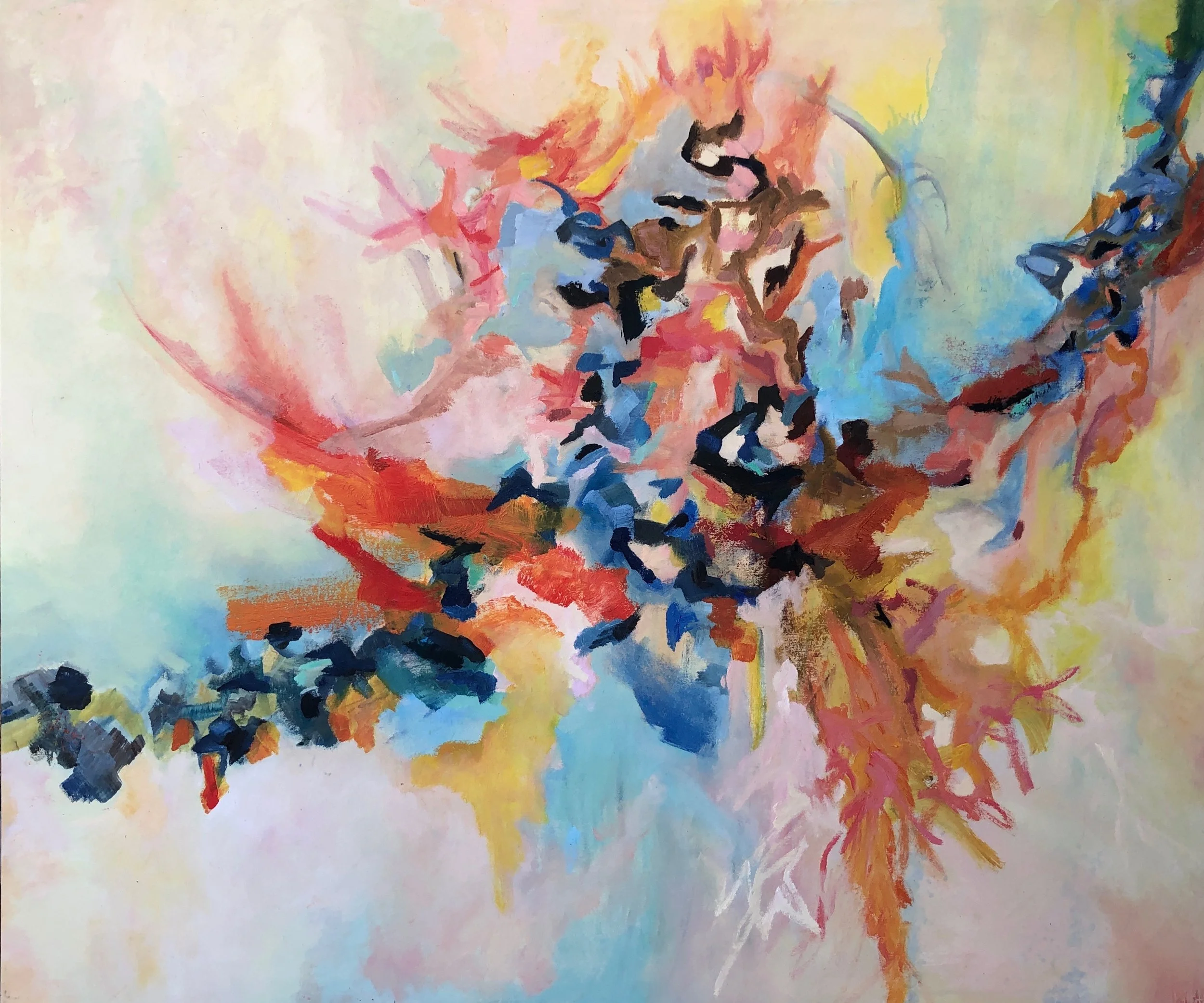
New Beginnings, 2020, Oil on canvas, 110 x 130 cm
Our first luxury store client was Céline — before Phoebe Philo. I am still grateful to the manager, a well-loved Frenchman with the accent every fan of Amélie would die for, who was the first to trust us with his clients. Balenciaga had just opened on Mount Street, we pitched our alterations service and not only got chosen but also recommended to the nearby store Stella McCartney. These few great names gave us the credentials we needed and the business took off. I remember the specific joy of having worked hard at something and being rewarded for it.
The work was unlike anything else. We altered pieces so valuable that Fendi once sent a bodyguard to sit in our workroom while we worked on a fur coat. I learnt a lot about our clients and their concerns could sometimes feel surprising — opening my eyes wide and expanding my knowledge of the world. I still think about the woman I fitted who had to travel for an upcoming wedding. Her main worry was that the credit crunch might force her husband onto a commercial flight instead of their usual private jet, and that the dress would crease. And then there was the day I fitted a Temperley on Yoko Ono and felt like I had met history herself.
We gave it our everything, both of us doing the fittings, the deliveries, managing the tailors, holding the vision, making sure that the quality was impeccable, that we had enough clients and enough money. We threw ourselves into it completely, to great results as the business grew quickly — maybe too fast. We started to disagree on almost everything and went from mending garments to tearing each other apart. But that's a story for another time. The business survived, and from 2011 I directed it alone.
By 2014, I have a large team, a contract with Harrods has just been signed, and the business is at its peak.
Why does it feel like something is missing?
I like the work, the team, and I am completely dedicated to our clients. But the wins are no longer thrilling. I feel like a spoiled child with too many toys. And as the business goes strong and my life mostly looks good, people struggle to understand why I feel dissatisfied. I feel guilty that I can't enjoy what I have, and lonely as no one understands. Friends will readily pity you for your failures, but they are considerably less sympathetic to your internal tantrums when you appear to be on top of your game.
To be continued…
May 2026
——————————————————————————————
Against Prudence
(A Manifesto)
There is a woman who lives in my head. She is old, dressed entirely in black, and well meaning. I imagine Prudence (as such is her name) to have been born in the depth of the 19th century, in a household where joy was considered a distraction and comfort a moral failing.
Her long and cumbersome dresses are austere and many times mended, she smells faintly of mothballs and holds the sceptre of certainty.
She tends to show her tightly chignonned head around 5am as she utters comments such as:
Is this really reasonable, in your situation?
Shouldn't you be doing real work?
It doesn't grow on trees, you know.
And off she goes, leaving me wide awake and ruminating.
The thing about Prudence is that she isn't wrong, exactly. She is saying that there are reality and consequences. That if you break your foot, you shouldn't run. It makes sense, but she is applying entirely reasonable logic to everything. She measures, and when she can't see an immediate return — what is the pay off on being excited about something? — she dismisses it as useless.
Most people have a job. A regular income, a number they can count on at the end of the month. I have chosen something else entirely — a painting practice and an alteration business that ebbs and flows with the market. Most months the numbers make sense. Some months Prudence has a point.
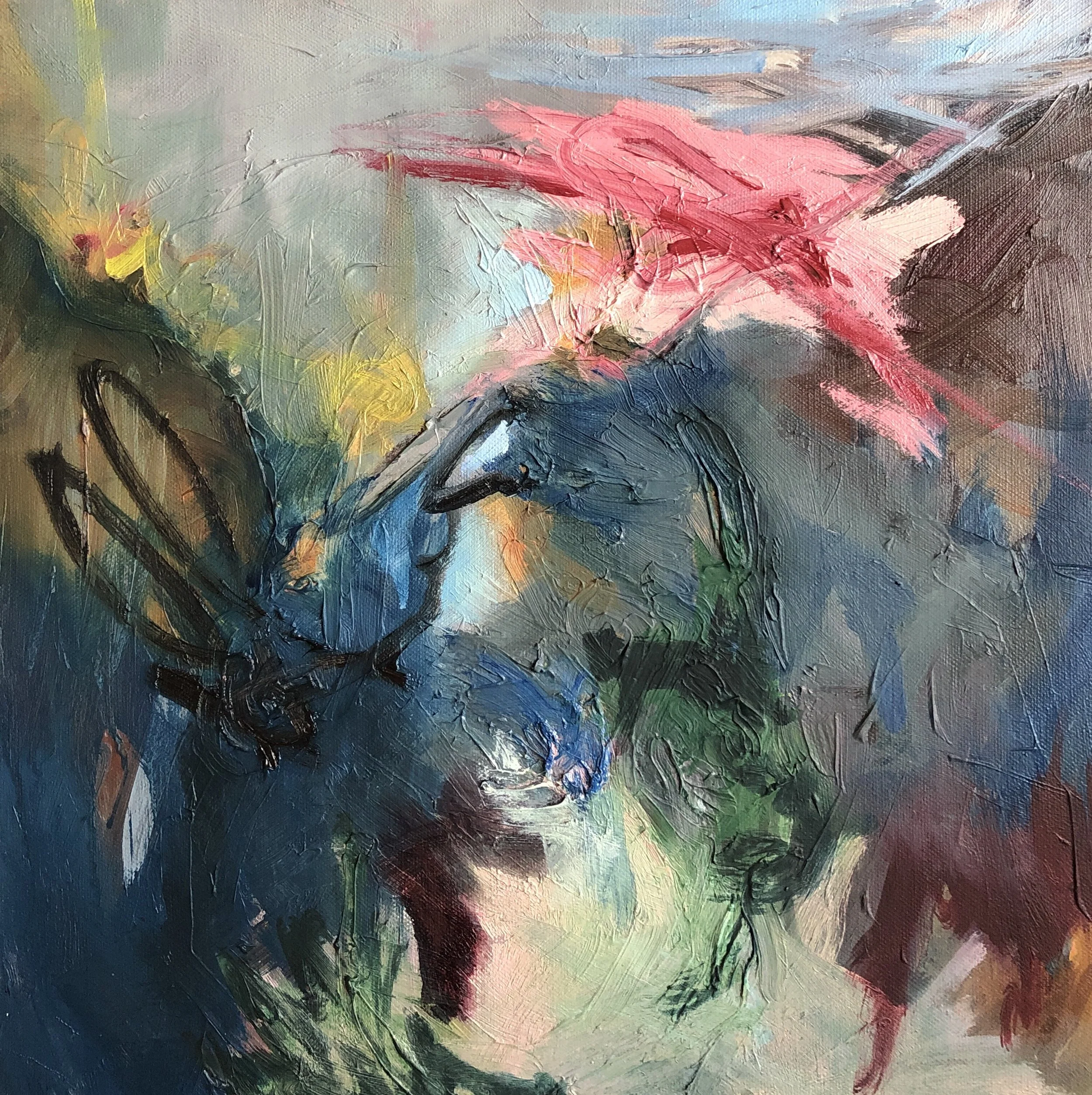
But what if she's been doing half the maths? She runs her numbers on fear and scarcity but she never considers that keeping me from risk might also be keeping me from a life worth living.
Tim Ferriss writes about fear-setting, and the question almost nobody asks: what is it costing you — financially, emotionally, physically — to postpone action? We are very diligent about calculating the risks of doing something, and we almost never calculate the risks of not doing it, what he calls the atrocious cost of inaction. What about the cost of taking the wrong action — the cautious one, the calculated one, (the one Prudence would approve of) instead of the one that comes from you as a deep desire?
Does the cautious path lead you somewhere you actually want to be? If the answer is no, cautious action is the greatest risk of all.
Prudence wants me to do my homework before I am allowed to play.
The difficulty is that the playing is the homework.
When I allow myself to be present and create without stressing about figures and returns, authentic work can happen. When I don't try to seduce or make sense, when I let raw ideas and sensation go out to the canvas — that is where the work is. There is something I can only describe as being completely and unreservedly alive. And this humanity cannot be faked and there is no shortcut to it. You need to take the necessary time to access it. And there is no guarantee. It may get you somewhere and it also may get buried and never seen, I don't know and it doesn't matter. What I know is that no work made “in order to” or for commercial purposes will move someone as effectively as the urgent one that comes out of you just because.
And here I face the oldest problem creative people have always had. How do we make a living without killing our creativity? How do we balance freedom and security? We all have our different ways and a different threshold of acceptance to the risk. I have built something that works and I know I am being impatient. But this period of unrest brings an economic unease that is felt by many of us, and uncertainty shakes our ground. Most of the time I am elated by creating and the freedom that comes with it. Other times I am reminded that this freedom has a cost. And if I know, deep down, that this is the life I want and no other, I also take a moment to recognise that it takes courage. And that I'm doing it, along with all my fellow artists, each in our own way. Pat on the shoulder — we deserve it.
April 2026
——————————————————————————————
Transfert
I arrive at the studio — early for once — and rejoice quietly in what lies ahead. I make a coffee and stand in front of the works from the day before. Several canvases are on the wall, each at a different stage, and I look at them in turn, waiting to feel which will call me first and tell me what it needs. My first task is to look and listen.

Inner Voice, 2024, Oil on canvas, 150 x 150 cm
There it is. The large canvas on the left clearly needs more red in the corner — this is my cue. I get changed into my painting gear, squirt some paint onto the palette — never pre-mixing the colours — and in I go, making the requested marks. From those, others come easily. And then more. The painting is talking to me. I am not in charge, it is leading me. Like a writer who discovers their characters have taken the story somewhere they never planned, I am simply following. It is a very nice feeling as I get to be surprised by what I create.
I work inch by inch, thinking only about the marks in front of me, not the canvas as a whole. And the fun arrives. Or so it should.
"Are you sure about that red? It might be too much. What's the overall direction here? Have you thought about how this will look when it's finished?"
Meet my old friend Fronty, supervisor of all things.
He works hard to make me stick to a brief that never existed. Neuroscience tells us that the prefrontal cortex is great at initiating a task but that to stay in flow, it must quieten its self-monitoring. In other words, Fronty needs to shut the f* up. But as the proud micromanager that he is, he never does — and tries to control the outcome, thus preventing any satisfying result from happening. The irony is entirely lost on him. The work, when Fronty is in charge, is without exception poor. So like a parent in desperate need of a moment to herself, I allow Fronty his screen time.
He needs to be kept busy with stories. Music doesn't work — he loses interest and wanders back. Thankfully he finds amusement in Transfert, a French podcast of deep intimate life moments told by the people who lived them. Its unfiltered voice gives him plenty to think about, and luckily, I enjoy it too. For English speakers, The Moth is the nearest equivalent, though I haven't found a perfect match.
I wonder sometimes whether living inside this podcast has quietly inspired these very posts — whether all that rawness and honesty has slowly made its way into my own need to write.
As Fronty gorges on the stories, I am free to feel my way onto the canvas instead of thinking it.
And yet, it slightly baffles me that to be fully present to the canvas, I need to be partially absent from it. I wonder if real mastery would be reaching this state without it — in silence, as a form of meditation. But I like a busy life with noise in it. I like the city, and people, and the hum of things happening. It is my own way into painting, not my Eat Pray Love. And there is travel, and connection. And paintings are being made.
April 2026
——————————————————————————————
Art Is Taking Over
I am sitting in a room on Harley Street and my therapist has just asked me to paint my feelings.
It is 2011. I am 34 and running a luxury alterations business that I built from nothing — the kind of thing that takes over your life in the best possible way until suddenly it is your life entirely, and you are the sole decision maker, which is energising and occasionally very lonely. I have always tried to understand myself better — to untangle the inevitable mishaps of childhood that follow us whether we invite them or not. So I am in therapy. What I haven't realised until now is that she is an art therapist — someone who uses painting, drawing, whatever form helps, to reach feelings that words can't always touch.

The Power Within, 2025, Oil on canvas, 183 x 122 cm
As I splash in reds and blues, trying to convey my inner feelings, I remember my 18 year old self as an art foundation student in Paris. I had loved it completely — the learning, the looking, the making. I carried a sketchbook everywhere for years. I was drawing in trains, parks and cafés — the friends opposite me, the strangers beyond them, whatever the world put in front of me. My friends were studying politics, law, journalism. I was the odd one out, sketchbook permanently open on the table, the group's artiste. I loved it enough to have continued, but pursued another calling that was even stronger, I wanted to learn to make clothes. Drawing stayed as a pleasure, until it disappeared, because life has a way of making you forget your own true joys sometimes.
Six years passed without a sketchbook. And now I find myself in this therapy room. I have developed feelings for a woman. Not entirely for the first time — but for the first time I am taking it seriously, investigating it with rigour. Which naturally includes watching The L Word on repeat. And who better to obsess over, as a newly found lesbian, than beautiful, problematic, damaged Shane? Oh how I enjoy these many drawings that I make as soon as I have some time and proudly present to my therapist — who decides Shane is a very handsome boy. (I will never know whether to blame her lack of lesbian culture or my poor drawing skills for the misgendering.)
Besides generally sorting myself out and understanding my sexual orientation, something unexpected is also happening. I can't stop drawing.
By 2014 I am taking formal classes one day a week at The Art Academy in London. I want to make sure I can draw before allowing myself to paint. I don't trust myself to give drawing its rightful place once I touch paint. So I work through modules of drawing, term by term, with the patience of someone who knows where they're going and is making themselves take the long way round — enjoying every moment of it.
When I finally get to painting it is an immediate, uncomplicated joy. As counter intuitive as it sounds, the more I do it the harder it gets. I heard somewhere that knowledge is like a balloon — the more air you put in, the larger the surface becomes, and the more you realise how much you have left to explore.
The real shift comes with abstraction. When I let go of representation — when I stop trying to paint a thing and simply paint — something loosens in me that I didn't know was tight. I discover that what I love is to start from nothing. A mark on the canvas, and then another, feeling my way toward a composition I couldn't have described before I made it. No plan. No expectation of how it should look. Fully present. Fully in it.
Meanwhile, I am still directing the business. I am training one day a week and painting every other moment I can find. I am trying to keep everything going at the same time — and mostly succeeding, because my team is strong and I have learned to trust them.
But paint is taking over. The water is already at my knees.
March 2026
——————————————————————————————
We Regret to Inform You
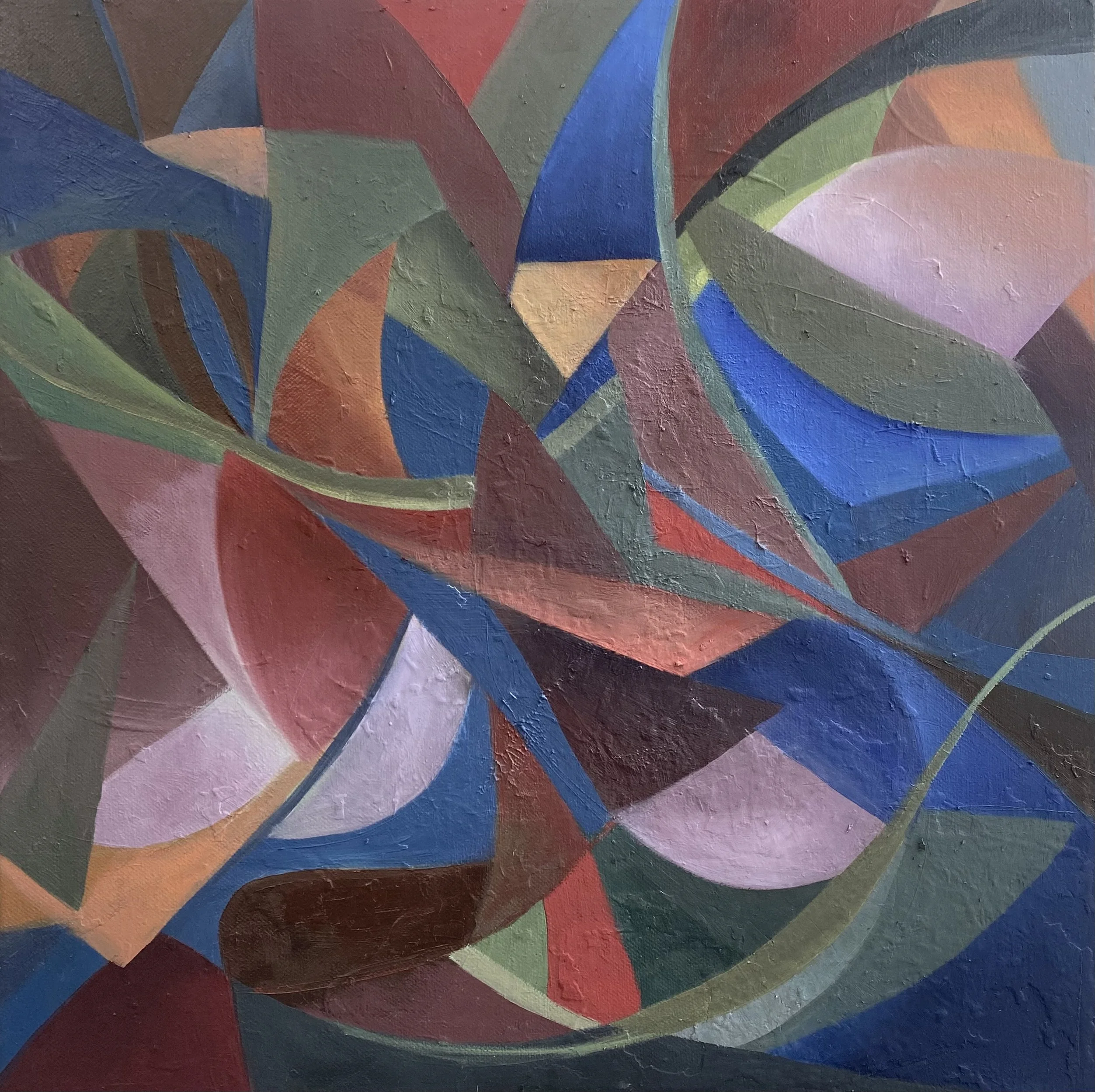
Spectrum, 2025, Oil on canvas, 40 x 40 cm
I woke up slow. Heavy, for no good reason. Nothing was wrong — I had projects, deadlines, things to crack on with. And yet every small item on my to-do list felt like a personal affront. I doomscrolled over coffee like any sensible procrastinator would, resisting the start of the day, stubborn donkey mode on. I couldn't understand it. All was well. Why did everything feel like wading through wet concrete?
And there it was.
Yesterday were the long awaited results for the RA Summer Show shortlist. For those unfamiliar, the Summer Exhibition at the Royal Academy is the world's oldest and largest open submission contemporary art show, running without interruption since 1769. Any artist, anywhere, can enter. Up to 18,000 do. Around 4,000 are shortlisted from digital images and invited to physically bring their work to Burlington House for a second round of judging. From those, roughly 1,700 make it into the show. You may agree, the odds are not good.
And yet. Every year, the same ritual — the odds quietly set aside, and the dream given full, embarrassing rein. I had dreamt the judges transfixed, the collectors fighting each other to get my painting, my website overwhelmed with traffic, Artsy sales flying. Kate Moss wouldn't manage to pronounce my name and we would laugh. Every conversation leading to opportunities, prestigious solo shows, and — of course — a Turner Prize, my art in every magazine, unicorns everywhere and, breaking news, the climate crisis resolved. The RA stamp affixed to my name like a hallmark — artist, verified, one to watch.
As the result came in — the other result — I told myself it was fine. Of course it was fine. The chances were slim, there were thousands of applicants, it's only one show, not that important anyway. I performed my own indifference so convincingly I almost believed it.
Except that minimising doesn't work. By shrinking my feelings and disappointment, I was shrinking myself. And often it feels better to brush it off, rather than feel vulnerable. Funny how it looks cooler to not care about things. Playing it down meant not allowing myself to grieve something I had genuinely wanted.
And unfelt, it goes sideways. Later that day I was with a fashion client — alterations, something I have done for twenty-five years — and suddenly I was replaying every past mistake, every fitting that hadn't gone smoothly, wondering whether I was actually any good at this either. One rejection, quietly colonising unrelated territory.
The moment I accepted and faced the disappointment, something shifted. The weight didn't disappear but it became something I could move.
I have chosen to be an artist and to be in this game, and it is a hard one. I had worked towards something, allowed myself real hope, and fallen down again. This result doesn't make my art better or worse. It simply didn't get me closer — and I had hoped it would.
The RA Summer Show is its own beast — wild, a little frightening, and like all myths, impossible to stop believing in. Not everyone admits it, but most of us try, and most of us feel its refusal more than we'd like to. Because it isn't just about this show. It's about the question underneath all of it: am I real? Do I count? Is anyone watching?
And with a sigh, I get back to the studio.
March 2026